
The report said that "we believe, institutions are more important than individuals" and ultimately what is important is the credibility and the independence of any institution and nothing else.

Costlier vegetables slowly pushed retail inflation, which had remained well within the Reserve Bank's comfortable level of 4 per cent during most part of 2019, peaked to more than three-year high of 5.54 per cent in November.

It's crucial for Modi to make India an easier place to do business.
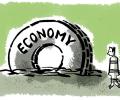
As he projected a grim outlook for the economy, RBI Governor said that amidst this encircling gloom, agriculture and allied activities have provided a beacon of hope on the back of an increase of 3.7 per cent in foodgrains production to a new record.

The broad market depicted strength. 1,525 shares rose and 1,131 shares fell. A total of 156 shares remained unchanged
The supply-side driven inflationary pressures, from food or fuel prices, would be mitigated by a neutral stance and a prolonged pause on rates, says Gaurav Kapur.
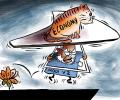
The reform priorities are clear: enhance savings, improve productivity. Just 25 basis points of moving interest rate up or down would not boost investment: Former RBI Governor Y V Reddy.

Despite admitting to price pressures both from food items and input prices, RBI Governor Shaktikanta Das on Wednesday hoped that a normal Southwest monsoon will have a "soothing impact" on inflation pressures and ruled out any wide variations in medium-term inflation forecast from what was given in April. In an unscheduled address earlier in the day amidst the raging pandemic, Das said the overall outlook for the economy is highly uncertain and is clouded with downside risks. He offered a slew of relief and liquidity measures to individuals and small businesses apart from a Rs 50,000 crore special liquidity window to the healthcare sector.

The Reserve Bank of India is expected to announce a slew of measures to bring vibrancy into the debt market as part of its mid-term review of the annual monetary policy.

Rate cuts are unlikely to be aggressive, in our view.

The Reserve Bank of India (RBI) on Wednesday announced an extension of interim ways and means advances (WMAs) limit of Rs 51,560 crore to state governments till September, to help them tide over the financial stress posed by the second wave of COVID-19. WMAs are temporary advances given by the RBI to the states to tide over any mismatch in receipts and payments. There are two types of WMA - normal and special. While normal WMA are clean advances, special WMA are secured advances provided against the pledge of the government of India dated securities.

Rajan had overturned the majority opinion of the members and chose to hold the rates at the last monetary policy review in October.

He will be the eighth Deputy Governor to be made Governor at RBI

It is the six per cent target RBI is more concerned about.

Currency scarcity weighed on manufacturing performance where growth of new work flows slowed

In twin blows to Indian economic revival, higher food prices drove retail inflation to a five-month high of 7.4 per cent while factory output fell for the first time in 18 months. The second consecutive month of rise in consumer price index (CPI)-based inflation will add to the pressure on the Reserve Bank of India (RBI) to again raise interest rates to tame high prices. Inflation has been above the targeted zone for the ninth month in a row and as per statute, the RBI will now have to explain to the government in writing why it failed to keep prices below 6 per cent.
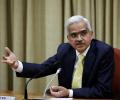
The government on Wednesday asked the Reserve Bank to maintain retail inflation at 4 per cent with a margin of 2 per cent on either side for another five-year period ending March 2026. To control the price rise, the government in 2016 gave a mandate to the RBI to keep the retail inflation at 4 per cent with a margin of 2 per cent on either side for a five-year period ending March 31, 2021.

Reserve Bank, in its mid term review of the monetary policy on Friday, decided to hike short term policy rate by 0.25 per cent after a gap of two years and ease liquidity by reducing the marginal standing facility rate for banks.
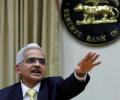
Probably in August. We can argue whether RBI is dovishly neutral or neutrally dovish but the telltale signs of at least one more rate cut are strewn all over the policy statement, points out Tamal Bandyopadhyay.
'There are deliberations on whether there can be lowering of income taxes and other sops to keep more money in the hands of taxpayers, enabling them to spend more and boost demand.'

The size of the hole in today's banking crisis appears to be roughly 10 per cent of GDP.

Achieving inflation target of 4 per cent, recovery after remonetisation and hardening profile of oil prices are some of the risks which the RBI is watching closely, says Gaurav Kapur.
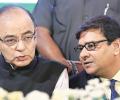
'For the RBI, for a central bank, reputational risk is the worst risk.' 'Credibility is the worst risk,'

Prices of food articles contracted by 3.47 per cent in June on a yearly basis. Vegetable inflation stood at (-)21.16 per cent.

Interview with former Reserve Bank of India governor by Duvvuri Subbarao.

SBI was the biggest loser in the Sensex pack, shedding 2.40 per cent, followed by Yes Bank, Bharti Airtel, L&T, Sun Pharma, M&M, ICICI Bank, ONGC, RIL, Asian Paints, Vedanta and HUL, which lost up to 2.37 per cent.
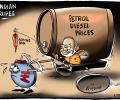
Retail inflation inches up to 3.77%; IIP growth dips to 3-month low

The government on Wednesday appointed RBI's senior-most executive director M Rajeshwar Rao as the deputy governor of the central bank. Rao was appointed to the post vacated by N S Vishwanathan, who stepped down three months ahead of his extended tenure on health grounds.

For protein rich items such as meat and fish, eggs as well as milk and products, the inflation in May slowed compared to last month
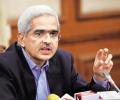
A staunch defender of demonetisation, it would be interesting to see how he handles the government's increasing demand for more cash from the RBI, and letting some weak banks get out of prompt corrective action.

Linking all new floating rate loans to an external benchmark won't impact existing borrowers, so customers who have taken long-term home loans recently should watch things carefully, say Joydeep Ghosh and Sanjay Kumar Singh.
With inflation remaining at elevated levels, central banks around the world, including the Reserve Bank of India (RBI), will kill excess demand in economy over the next six to eight months, sources in the know said. They also indicated that there could be a rate hike in June, when the inflation forecast for the current financial year would be raised. The RBI, the sources said, might announce more steps such as raising the limit on held-to-maturity (HTM) bonds to support government borrowings but might not come out with any further quantitative easing GSAP (Government Securities Acquisition Programme) measures.

Kaushik Basu, whose stint at the World Bank ends on July 31, was being looked at as a serious contender, the sources said
The Reserve Bank (RBI) resisted a 'raid' planned by some in the government to extract Rs 2-3 lakh crore from its balance sheet in 2018 to meet populist spending in run-up to general elections, Viral Acharya, who was deputy governor at RBI at that time, has written.

The finance ministry has received about 100 applications for the post, which have been sent to the high-level panel that will select a suitable candidate for the post, sources said.

Raghuram Rajan rejected the argument that inflation has come down largely because of "good luck" stemming from low oil prices.

Here are the key decisions announced by the Reserve Bank of India on Thursday.
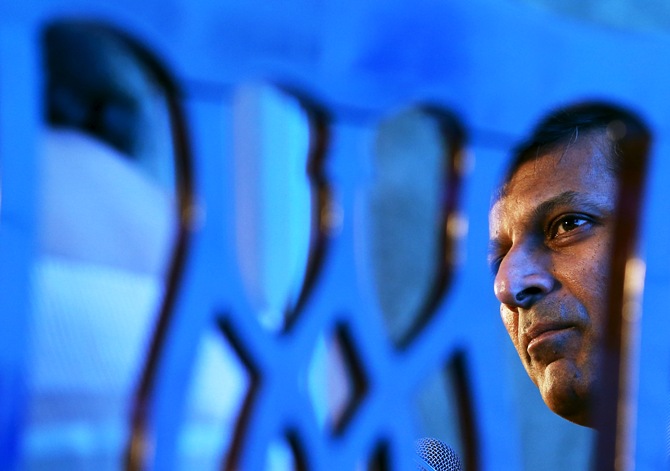
The RBI Governor brought down retail inflation to 3.8% in July.

The cost of holding one-year forward dollars rose to 482.75 basis points from 472.75 bps on Tuesday.

The report, however, said it remains watchful of the upside risks to inflation emanating from pass-through of minimum support prices (MSPs), adverse movement in crude oil prices, volatility in global financial markets, lagged impact of the rupee weakness on input prices, adverse implications from fiscal slippage and staggered impact of HRA increases by states and its second-round impact.
